Mastering Affiliate Marketing Program Management: An Actionable Guide


Effective affiliate marketing program management isn't just about oversight; it's about actively building and nurturing partnerships to drive measurable revenue. To succeed, you must execute a hands-on strategy that involves recruiting the right partners, arming them with the tools they need to win, meticulously tracking performance, and ensuring they get paid on time for every sale they generate.
Building Your Program's Strategic Foundation
Before inviting your first affiliate, you must lay a solid groundwork. A high-performing program is built on smart, deliberate decisions from the start. This foundational stage is where you define what success looks like, establish your commission structure, and choose the technology to make it happen.
Don't underestimate this channel's power. The affiliate marketing industry is projected to jump from $18.5 billion in 2025 to a staggering $31.7 billion by 2031. With over 80% of advertisers already leveraging this channel, a strong, actionable foundation is non-negotiable.
Defining Your Business Goals and Commission Model
First, define your objective. Your business goals must translate directly into your program's KPIs. Are you aiming to increase sales volume, acquire net-new customers, or boost average order value (AOV)? Your answer will dictate your entire strategy, especially your commission model.
For example, a SaaS company needing more trial sign-ups should implement a Cost-Per-Lead (CPL) model, paying affiliates for each qualified lead. An e-commerce store, however, will almost certainly use a Cost-Per-Sale (CPS) model, giving partners a percentage of each completed purchase.
Action Step: To attract top-tier affiliates, you must clearly articulate your brand's value. Take time to learn how to create an effective value proposition that convinces premier partners they should work with you over your competitors.
Deciding on the right commission model is one of the most critical actions you'll take. Use this table to align your business goals with a specific payment structure.
Key Affiliate Commission Models Compared
| Model Type | Best For | Pros | Cons |
|---|---|---|---|
| Cost Per Sale (CPS) | E-commerce, direct-to-consumer products | Low risk (pay only on revenue), easy to track | Can be less attractive for content creators who don't drive direct sales |
| Cost Per Lead (CPL) | SaaS, B2B services, high-ticket items | Pay for potential customers, great for building a sales funnel | Leads may not always convert, risk of lower quality leads |
| Cost Per Click (CPC) | Building brand awareness, driving high traffic volumes | Simple to understand, rewards traffic generation | High risk of fraud, doesn't guarantee sales or conversions |
| Flat-Fee / Bounty | Subscription services, app installs | Predictable costs, attractive one-time payout for affiliates | May not incentivize long-term promotion or high-value customers |
Ultimately, your chosen model signals to affiliates what actions you value most. A well-aligned structure ensures you only pay for outcomes that directly impact your bottom line.
Choosing the Right Affiliate Tech Stack
Once your strategy is clear, you need technology to execute it. This decision determines your day-to-day workflow. You have two primary options: join an established affiliate network or manage your own program with dedicated software.
Here’s an actionable breakdown:
- Affiliate Networks: Platforms like Awin or CJ Affiliate offer access to a vast, pre-existing pool of affiliates. They manage tracking, reporting, and payments. The trade-off is higher fees and less brand control. Choose this if: You need to ramp up recruitment quickly and are willing to pay a premium for access and convenience.
- SaaS Platforms: Solutions like PartnerStack, Affise, or Referly provide full control over your program's branding and operations. You'll build your affiliate base from scratch but benefit from lower fees and direct partner relationships. Choose this if: You want to build a long-term, branded partner ecosystem and maintain direct control over your data.
This choice is critical because it dictates how you spend your time.
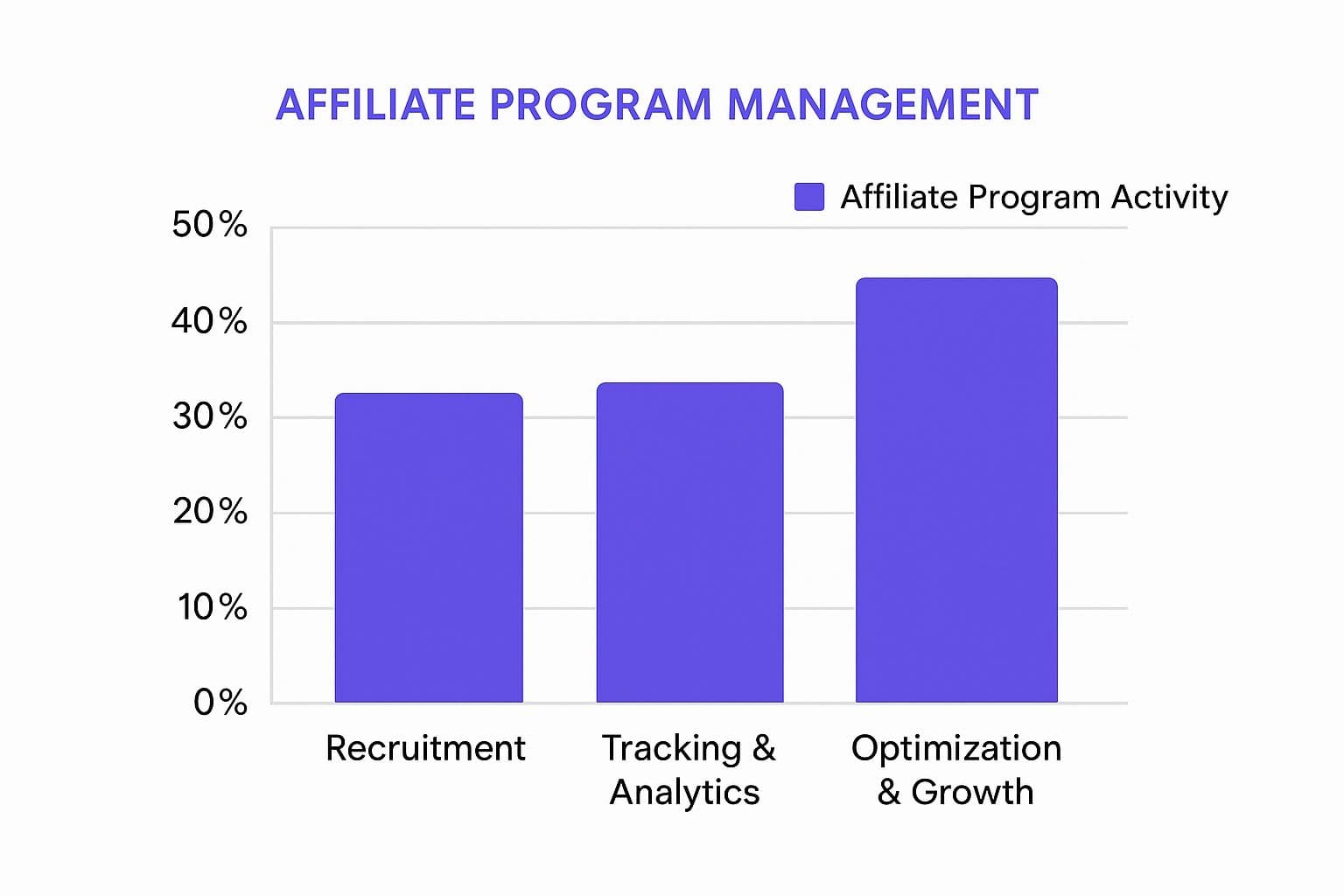
As this data shows, nearly half of a manager's time is dedicated to optimization and growth. This makes selecting a platform with robust, intuitive analytics an absolute necessity. You need to be able to see what’s working and what isn’t, then act on that data swiftly. A solid foundation here allows you to attract the right partners and scale your program effectively.
How to Recruit Affiliates Who Actually Drive Sales

An affiliate program is only as good as its partners. The outdated "spray and pray" outreach method is a waste of time, filling your program with inactive accounts that never produce a sale. To build a program that generates real revenue, you must strategically recruit partners who are a genuine, enthusiastic fit for your brand.
This begins with a crucial mindset shift: you're not just looking for anyone with a website. You are on a targeted mission to find specific creators, niche experts, and influencers whose audience trusts their recommendations. In affiliate recruitment, quality always trumps quantity.
Create Your Ideal Partner Profile
Before sending a single outreach email, create a crystal-clear profile of your target affiliate. An Ideal Partner Profile (IPP) acts as your recruitment blueprint, much like a buyer persona.
Your IPP should provide actionable answers to these questions:
- Audience Alignment: Do their followers’ demographics, interests, and pain points match your ideal customer profile?
- Content Platform & Style: Where do they create? Are they masters of in-depth blog posts, quick-hitting TikTok videos, or polished YouTube reviews? Match their style to where your product shines.
- Engagement Metrics: Look beyond follower counts. A micro-influencer with a 3-5% engagement rate is far more valuable than a macro-influencer with a passive audience and 1.7% engagement.
- Niche Relevance: A fitness blogger reviewing workout gear is a perfect match. A tech reviewer for a skincare line is a waste of everyone's time.
A well-defined Ideal Partner Profile transforms recruitment from a guessing game into a targeted, efficient hunt. It stops you from wasting resources on misaligned partners and focuses your energy on high-potential relationships.
Hunting for Affiliates in the Wild
With your IPP as your guide, it’s time to find your future top performers. The most effective recruitment strategies mirror those used by top influencer marketing agencies, focusing on authentic reach and audience alignment.
Here are three actionable tactics to build your prospect list today:
- Reverse-Engineer Your Competitors: Identify your top competitors and use tools like Ahrefs or SEMrush to see which websites link to their product pages. These are often their top-performing affiliates and a prime source for your own outreach.
- Explore Niche Content Hubs: Go where your target audience learns and socializes. Use specific search queries like "best [your product category] blogs," "top [your niche] YouTubers," or "[your industry] podcasts" to discover passionate creators with loyal followings.
- Monitor Social Media Hashtags: Actively track relevant hashtags on Instagram, TikTok, and X (formerly Twitter). Look for creators already discussing products in your category who have a vibrant, engaged community. These individuals are pre-qualified and often receptive to partnerships.
Crafting Outreach That Actually Gets a Response
Your initial outreach email is your first impression. A generic, copy-pasted template is a one-way ticket to the trash folder. To get a response, you must personalize your message to prove you've done your research and genuinely believe in a mutual partnership.
An effective outreach email must contain these four elements:
- Specific, Genuine Praise: Reference a recent piece of their content. "I loved your recent video on home workout routines…" immediately shows you're not a bot.
- The "Why You": Clearly state why you believe their specific audience will benefit from your product. Connect your product's features to their audience's needs.
- The Value Proposition: Be direct about what's in it for them. State your commission rate, cookie duration, and any extra perks like free products or exclusive access.
- A Clear, Low-Friction Call to Action: Make it incredibly easy to say yes. Provide a direct link to your affiliate sign-up page or suggest a brief introductory call.
A Seamless Onboarding Experience
A "yes" is only the beginning. A smooth, welcoming onboarding process is what converts an interested new partner into a confident, long-term brand advocate. A confusing start can extinguish all initial excitement. For partners just learning how to start an affiliate marketing business, a structured onboarding is vital.
Your welcome sequence must equip them for immediate success. Action Step: Create a dedicated resource hub or "welcome kit" in your affiliate portal that includes:
- A personal welcome letter from you, the affiliate manager.
- Simple brand guidelines on logo usage and brand voice.
- A library of creative assets: banners, product photos, social media templates.
- Easy access to their unique tracking links and a quick tutorial on how to use them.
This organized, supportive start demonstrates your investment in their success, empowering them to start driving the sales you recruited them for right away.
Keeping Your Affiliates Active and Engaged

Recruiting affiliates is just step one. The real work—and where most programs fail—is in activation and engagement. An impressive roster of partners is meaningless if most of them go silent after signing up. This is the core challenge of affiliate marketing program management.
That long list of inactive partners represents a massive revenue leak. The solution isn't just sending more emails; it's about building genuine relationships and consistently providing actionable value that keeps your brand top of mind and easy to promote.
Move Beyond Generic Communication
Most affiliate newsletters are boring, promotional blasts that get ignored. To cut through the noise, your communication must do more than announce a sale—it must actively help your partners succeed.
Action Step: Transform your communication from a sales bulletin into an empowerment tool. Instead of just saying, "We have a 20% off sale!" try this: "Our 20% off sale is perfect for first-time buyers struggling with [problem]. Here are three content angles you can use to promote it on Instagram." This is what builds a true partnership. To master this, review our guide on email marketing for affiliates.
The goal of affiliate communication isn't just to inform, but to inspire action. A partner who feels equipped and supported is a partner who actively promotes your products.
This strategic shift turns your emails from a nuisance into a resource they look forward to, proving your investment in their success and encouraging them to invest in yours.
Equip Partners for Maximum Impact
Your affiliates are content creators, not always platform-specific marketing experts. One of the most powerful engagement strategies is providing resources that help them grow their own business. A larger, more engaged audience for them means more potential sales for you.
For example, offering a guide on how to increase Instagram followers organically provides immense value beyond your program, building deep, long-term loyalty.
On a tactical level, you must keep your creative assets fresh. Don't force partners to use the same banner ad for six months. A stale creative tells them your program is on autopilot. Action Step: Maintain a rolling 30-day calendar for new creative assets, including:
- Seasonal Graphics: Banners for Black Friday, Mother's Day, and other key holidays.
- Video Clips: Short, shareable videos optimized for TikTok, Reels, and Shorts.
- Updated Messaging: Fresh copy and talking points that highlight new product features.
Spark Excitement with Strategic Incentives
Even top partners can lose momentum. Strategic incentives are the perfect tool for reigniting focus and driving performance surges. This is a core function of proactive affiliate marketing program management.
Here are three powerful incentive campaigns you can implement this quarter:
- Activation Bonus: Target affiliates who have signed up but have zero sales. Offer a $25 cash bonus for generating their first commission within 30 days. This small nudge is incredibly effective at overcoming initial inertia.
- Tiered Commission Bumps: Reward top performance without permanently raising costs. Offer a 5% commission bonus for any month an affiliate drives over $5,000 in sales. This gives your best partners a clear, motivating target.
- Sales Contests: Spark friendly competition with a monthly leaderboard. Offer prizes for the top three affiliates, such as cash bonuses, new products, or a feature in your next newsletter.
These tactics create moments of excitement, break the monotony of standard promotion, and reward the exact behaviors that grow your program. By blending relationship-focused communication, valuable resources, and smart incentives, you can transform a passive contact list into a high-performance sales team.
Using Data to Optimize Program Performance

Data-driven decision-making is what separates amateur program managers from professionals who deliver consistent results. It’s easy to get distracted by vanity metrics like clicks. Effective affiliate marketing program management demands a laser focus on the numbers that directly impact revenue and profitability.
Your affiliate dashboard is your command center. Use it to find the truth about what’s working, what’s failing, and where your greatest growth opportunities are hiding.
Identify the KPIs That Truly Matter
Not all metrics are created equal. To get a clear picture of your program's health, you must track specific Key Performance Indicators (KPIs) that reveal the quality of your affiliate traffic and its ability to convert.
Of course, you’ll track baseline metrics like conversion rate and total sales. This is where dedicated affiliate tracking software is essential, providing the real-time data needed for smart decisions. You can learn more about how technology enables modern affiliate management on payquicker.com.
Here are the core KPIs to monitor on a weekly basis:
- Conversion Rate (CR): The percentage of clicks that result in a sale. A high click volume with a low CR signals a mismatch between the affiliate's audience and your offer.
- Average Order Value (AOV): The average amount customers spend per order via an affiliate link. A rising AOV indicates affiliates are attracting high-value customers.
- Earnings Per Click (EPC): The average revenue generated per click. This is the most efficient metric for comparing the profitability of different partners.
- New vs. Returning Customers: Are your affiliates acquiring new customers or just getting credit for sales from your existing audience? A healthy program must be an engine for new customer acquisition.
Pinpoint and Empower Your Top Performers
In almost every affiliate program, the Pareto Principle holds true: roughly 80% of your sales will come from 20% of your partners. Your first action item is to use your data to identify this elite group.
Action Step: In your affiliate platform, run a report ranking partners by commission earned over the last 90 days. This is your VIP list. Unlocking the secrets to their success is the key to scaling the entire program.
Don't just reward your top affiliates—decode their success. By understanding what makes them effective, you can create a playbook to help your mid-tier partners level up and improve the performance of the whole program.
Once you’ve identified your top performers, become a detective. Find out exactly what they are doing right:
- Promotional Methods: Are they using in-depth product reviews, video tutorials, or targeted email promotions?
- Content Angle: What specific pain points or benefits are they emphasizing?
- Audience Engagement: How do they build trust with their followers before presenting a link?
Get on a call with them. A 15-minute chat can reveal insights you’ll never find in a report. Ask them what's working and what resources you could provide to help them sell more. This builds a stronger relationship and often uncovers new promotional strategies you can share with your entire partner base.
Diagnose and Support Underperforming Partners
It’s equally important to understand why some affiliates are failing. A partner sending hundreds of clicks with zero sales is not a lost cause; they are an optimization opportunity.
When you identify an underperformer, don't ignore them. Investigate the root cause with this actionable framework:
| Potential Issue | Diagnostic Question | Actionable Solution |
|---|---|---|
| Audience Mismatch | Is their content focus too broad or completely unrelated to your product? | Suggest a more specific content angle that aligns their audience's interests with your product's benefits. |
| Ineffective Tactics | Are they just placing a banner ad in their sidebar instead of creating valuable content? | Share examples of your top affiliates' content and provide them with fresh creative assets or talking points. |
| Lack of Engagement | Have they gone silent since signing up? Are they even aware of your latest promotions? | Send a personal check-in email. Offer a small "first sale" bonus to reactivate their interest and get them motivated. |
This proactive affiliate marketing program management turns struggling partners into productive ones. It proves you're invested in their success, which encourages them to invest more effort in promoting you. Continuously analyzing your data and acting on it is the most reliable path to a profitable, scalable affiliate program.
Scaling Your Program While Managing Risk
Your program is generating consistent, profitable revenue. The natural next step is to scale aggressively. However, scaling too quickly without proper guardrails is a direct path to brand damage and budget-draining fraud.
At this stage, your role shifts from manager to strategist. It’s less about day-to-day tasks and more about protecting your assets while pushing for intelligent growth. Here’s how to grow your revenue without sacrificing quality or integrity.
Advanced Recruitment for New Markets
To expand into new markets or tap into different audiences, you need to upgrade your recruitment tactics for speed and credibility.
Here are two powerful strategies for smart scaling:
- Go Deep with Niche Agencies: Instead of recruiting one affiliate at a time, partner with a specialized affiliate agency in your niche (e.g., SaaS, fashion, home goods). These agencies provide immediate access to a vetted network of high-quality content creators, giving you an express lane to perfect-fit partners.
- Launch a Sub-Affiliate Program: This advanced tactic empowers your most trusted top performers to become recruiters. They onboard their own sub-affiliates, and you pay your primary partner a small override commission on sales generated by their recruits. This creates a powerful, self-sustaining growth engine.
These strategies can accelerate growth, but it's crucial to understand the nuances of different partnership types. For a deeper dive, review our guide on affiliate marketing vs influencer marketing.
Combating Fraud and Protecting Your Brand
As your program grows, so does the target on its back. Bad actors are drawn to success, making proactive fraud prevention non-negotiable for protecting your budget and brand reputation. Fraud can silently destroy your ROI by attributing sales to partners who provided zero value.
A dollar spent preventing fraud is worth more than a dollar clawed back after the fact. Protecting your program's integrity ensures sustainable growth and maintains the trust of your legitimate partners.
You must be able to identify and shut down common fraud schemes quickly.
Common Affiliate Fraud Schemes to Watch For
| Fraud Type | How It Works | How to Spot It |
|---|---|---|
| Trademark Bidding | An affiliate violates your terms by bidding on your branded keywords (e.g., "Referly discount") in Google Ads, stealing last-click attribution for sales that were already coming to you. | Use a brand monitoring tool to scan for ads using your trademarks. Watch for affiliates with suspiciously high conversion rates from paid search traffic. |
| Cookie Stuffing | An affiliate uses scripts or pop-ups to drop tracking cookies onto a user's browser without their knowledge, claiming credit for any subsequent purchase. | Monitor for affiliates with an abnormally high click-through rate but an extremely low conversion rate. This is a classic indicator of cookie "spraying." |
| Typosquatting | Affiliates register domains that are common misspellings of your brand (e.g., "pushlapgroth.com") and redirect traffic through their affiliate link to hijack commissions. | Periodically search for common misspellings of your domain. Set up alerts for new domain registrations that are confusingly similar to your brand name. |
Creating Ironclad Program Terms
Your primary defense is a rock-solid affiliate agreement. Vague terms create loopholes for bad actors. Your terms of service must be explicit, detailed, and leave no room for interpretation.
Think of your agreement as a core tool for your affiliate marketing program management. It sets clear expectations and gives you the legal standing to remove bad actors swiftly.
Your agreement must clearly forbid:
- Paid Search Bidding: Explicitly forbid bidding on your brand name, misspellings, and "brand + term" variations (e.g., "Referly coupon").
- Coupon Usage: Specify that partners can only promote codes you provide directly. Prohibit the use of fake or expired codes to attract clicks.
- Brand Misrepresentation: Define how your brand and products can be represented. Outlaw misleading claims and spammy promotional tactics.
- Consequences of Violation: State that any violation will result in immediate termination and forfeiture of all pending commissions. This is your most powerful enforcement tool.
By pairing advanced recruitment with vigilant fraud monitoring and an ironclad agreement, you can scale your program confidently, growing revenue while protecting the brand you've worked so hard to build.
Answering Your Top Affiliate Management Questions
Even experienced marketers have questions when diving into affiliate program management. You're not just running campaigns; you're building a network of sales partners.
Let’s tackle the most common questions managers face. Getting these answers right will save you significant time and prevent costly mistakes.
What's the Single Biggest Challenge I'll Face?
Consistent partner activation. Getting affiliates to sign up is easy. The real challenge is keeping them engaged and actively promoting your brand month after month. You are in a constant battle for their attention.
Programs fail when managers treat recruitment as the finish line. It's the starting gun. Your job is to build real relationships through consistent communication, fresh creative assets, and performance incentives that make promoting you an easy choice. This is a relationship-driven channel, not "set it and forget it."
How Much Should I Actually Pay My Affiliates?
There is no single magic number. The right commission must be high enough to attract quality partners but sustainable for your profit margins.
Here’s an actionable starting point:
- Digital Products & SaaS: With high margins, a 20-40% commission is standard and competitive.
- Physical Goods & E-commerce: Due to production and shipping costs, a 5-15% commission is more common.
Action Step: Start with a Cost-Per-Sale (CPS) model. This is the lowest-risk approach, as you only pay for confirmed revenue. As your program matures, implement a tiered structure to motivate top performers: once they reach a specific sales volume, they unlock a higher commission rate. It's a win-win.
"There's no universal 'right' commission. Start by researching what your direct competitors offer. The goal is to be attractive but financially smart. A tiered model is a fantastic way to reward your top 20% without overpaying the other 80%."
How Often Do I Need to Communicate with My Partners?
To stay top-of-mind, maintain a steady communication rhythm. A monthly or bi-monthly newsletter is a solid baseline for your entire list. Pack it with value: new product info, upcoming promotions, content ideas, and conversion tips.
Your top performers, however, require a personal touch. They drive the majority of your results. Action Step: Send a personal one-on-one email or schedule a brief call every 4-6 weeks. This shows you value the partnership, strengthens the relationship, and often uncovers new collaboration opportunities.
What Are the Must-Have Tools for Managing All This?
Your most critical tool is a reliable affiliate tracking platform. This is the central nervous system of your program, handling link tracking, performance data, and commission payouts. Do not attempt to manage this with a spreadsheet.
Beyond that, these tools will make your life significantly easier:
- Email Marketing Service: Essential for sending newsletters and segmenting your communication by performance.
- A Simple Design Tool (like Canva): For quickly creating new banners and social graphics to keep partner content fresh.
- Analytics Software (like Google Analytics): To see what happens after the click and gain deeper insights into the traffic quality from each partner.
The right tech stack automates tedious administrative tasks, freeing you up to focus on the one activity that truly grows a program: building strong relationships with your partners.
Ready to stop juggling spreadsheets and start scaling your revenue? Referly provides all the tools you need for effective affiliate marketing program management in one intuitive platform. From a fully branded portal to automated payouts and a marketplace of qualified affiliates, we simplify the complexities so you can focus on growth. Start your 14-day free trial today.
Keep reading
Affiliate Marketing vs Influencer Marketing: Which Is Better?
Discover the key differences between affiliate marketing vs influencer marketing to choose the best strategy for your business success.
How to Set Up an Actionable Affiliate Program for Squarespace
Launch a successful affiliate program for Squarespace. Learn how to set up tracking, recruit quality partners, and drive more sales for your online store.
Your Guide to an Affiliate Program Manager: From Strategy to Action
Discover the essential skills, strategies, and responsibilities of an affiliate program manager. Learn how to drive growth and build successful partnerships.